Are there still griots today?
 Daniel Moore
 .
In respect to this, where do griots live?
Role of griots Griots today live in many parts of West Africa and are present among the Mande peoples (Mandinka, Malinké, Bambara, etc.), Ful?e (Fula), Hausa, Songhai, Tukulóor, Wolof, Serer, Mossi, Dagomba, Mauritanian Arabs, and many other smaller groups.
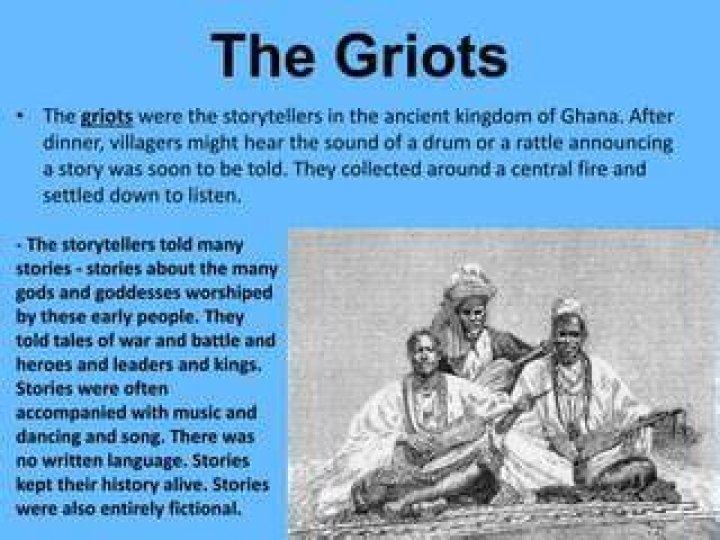
Also Know, how do griots tell stories? They tell their stories to music using four principal instruments—the kora (a 21-string lute that sounds like a harp), the balafon, the ngoni, and the voice. Griots usually carry this important responsibility from one generation to the next so that their stories may never be forgotten or lost.
Thereof, why is a griot important?
The griots were important to West African society because they were the ones that had the good memory. Also they were important because they were the ones who told the stories to the other people. They were also important because they were the people who told the stories about the hajj.
What did griots wear?
The role eventually evolved into one of advising nobility and serving as messenger to the community. Griots have worn (and still do wear!) many hats within their communities. They are the historians, genealogists, musicians, advisors to nobility, storytellers, advocates, messengers, ambassadors, and praise singers.
Related Question Answers
What is another word for Griot?
Synonyms: griot. Definition: a storyteller in West Africa; perpetuates the oral traditions of a family or village. Similar words: storyteller, teller, narrator.What did the griot often memorize?
Griots were also the historians of Ancient Africa. They would keep track and memorize the history of the village including births, deaths, marriages, droughts, wars, and other important events. The stories and historical events would then be passed down from generation to generation.What does griot mean in history?
noun. a member of a hereditary caste among the peoples of western Africa whose function is to keep an oral history of the tribe or village and to entertain with stories, poems, songs, dances, etc.What are the current occupations of griots?
The current occupations of griots are musicians that make music and sell it.What is oral tradition in history?
Oral tradition is information passed down through the generations by word of mouth that is not written down. This includes historical and cultural traditions, literature and law.What did Mansa Musa do?
Mansa Musa, fourteenth century emperor of the Mali Empire, is the medieval African ruler most known to the world outside Africa. His elaborate pilgrimage to the Muslim holy city of Mecca in 1324 introduced him to rulers in the Middle East and in Europe.What is Mali culture?
The culture of Mali derives from the shared experience, as a colonial and post-colonial polity, and the interaction of the numerous cultures which make up the Malian people. Tuareg and Maure peoples continue a largely nomadic desert culture, across the north of the nation.What is the griot tradition?
Griots (meaning “blood of the society” in Mandinka language) are West African musicians, praise-singers, historians, storytellers, poets and advisors whose practices originate from 13th century Mali Empire. They are akin to living libraries who perpetuate wisdom and knowledge through the oral tradition.What does a griot do?
A griot is a West African storyteller, singer, musician, and oral historian. They train to excel as orators, lyricists and musicians. The griot keeps records of all the births, deaths, marriages through the generations of the village or family.Why may an oral history provide?
Oral history allows you to learn about the perspectives of individuals who might not otherwise appear in the historical record. While historians and history students can use traditional documents to reconstruct the past, everyday people fall through the cracks in the written record.How is Mansa Musa?
He was the first African ruler to be widely known throughout Europe and the Middle East, and is regarded as the richest person to have ever lived. His wealth greatly surpassing anyone today. Mansa Musa was the great nephew of Sundiata Keita, who was founder of the empire. He is famous for his Hajj (1324–5).What do oral traditions say about African society?
Oral Traditions make it possible for a society to pass knowledge across genera- tions without writing. They help people make sense of the world and are used to teach children and adults about important aspects of their culture. There is a rich tradition throughout Africa of oral storytelling.Why was storytelling important in Africa?
Storytelling in Africa provides entertainment, satisfies the curiosities of the African people, and teaches important lessons about everyday life. It is essentially a communal participatory experience. Repetition of the language and rhythm are two important characteristics of oral storytelling in Africa.Where was Timbuktu located?
Mali