The answer, briefly, is no -- freezing will not make your water safe to drink. Freezing does damage living cells, mostly because water expands when freezing, and ice crystals can break the cell walls. Thus, some bacteria will be killed by freezing. However, freezing does NOT sterilize food or liquids..
Likewise, does freezing disinfect?
Freezing does not kill germs and bacteria. Instead, it essentially puts them into hibernation. They are inactive while the food is frozen and will “wake up” as soon as the food thaws.
can bacteria survive in freezing temperatures? No,freezing cannot kill all types of Bacteria. There are several Bacteria which are resistant to cold temperatures. It kills many of the bacteria, but often not all of the bacteria. Some species / strains survive freezing better than others, a very few species can even grow in freezing conditions.
Likewise, can Salmonella survive freezing?
Freezing or refrigerating food will not kill salmonella, although it will stop the bacteria from reproducing. Further, thoroughly cooking food can kill salmonella, but it does not guarantee that the food is safe to eat if proper food handling processes were not followed (e.g., if cross contamination occurred).
Does freezing kill germs on toys?
Kill viruses on wooden toys by freezing them. Wiping them works for dirt, but freezing them kills germs.
Related Question Answers
Will freezing kill E coli?
Freezing does not destroy these bacteria. E. coli O157:H7 survive refrigerator and freezer temperatures.Is vitamin C destroyed by freezing?
Freezing resulted in a total of 45.7% loss and this percentage reached 51.8 at the end of 6 months of frozen storage. Vitamin C levels during the freezing process and subsequent storage period were significantly different (P < 0.05) in comparison with the initial value.Do cold air kill germs?
Cold air doesn't kill germs but it can keep them from spreading. Cold weather restricts the growth of bacteria. At 32 degrees Fahrenheit or lower, you will get virtually all bacteria or viruses to be inactive.Can Listeria be killed by freezing?
Although freezing temperatures will prevent Listeria bacteria from growing, they don't kill the bacteria, Chapman said. The microbes survive in the freezer, he said. In addition, Listeria are among the few bacteria that can actually multiply at refrigerator temperatures, according to the CDC.Do germs get killed in the dryer?
It's not so much the heat, per se, of the dryer that kills germs, bacteria, etc. It's the dryness. Drying is a pretty good sterilizer - it kills most everything. Some bacteria will sporulate (as will fungi, and molds) and will regenerate when wet again, but they typically can't do so in the time frame of a dryer cycle.Does the freezer kill germs on clothes?
Toss your most-worn clothing in the freezer, and you'll be able to snag one more wear out of them before adding them to the growing pile of laundry. The same goes for workout wear, according to Bustle, as the freezer kills the bacteria that causes both smell and mildew in your sweatiest wear.What happens to viruses when food is frozen?
What happens to viruses when food is frozen? Viruses are not destroyed by cold, they are preserved and can remain infectious. Deep freezing is how virus samples are preserved in microbiology labs. In 2012 over 500 schools in Germany were seriously affected by a norovirus outbreak that made over 11000 children ill.How do you wash jeans without washing them?
To do this, lay jeans flat in the bathtub and fill to cover with cool to cold water. Add one cup of regular white vinegar to the water and swish it around to distribute it evenly. Leave jeans to soak for about an hour, then wring out the excess liquid (no need to rinse) and hang jeans by the waistband to dry.Does freezing kill E coli and salmonella?
No. Freezing can kill some bacteria, but others can survive both refrigerator and freezer temperatures. coli O157:H7, and Salmonella are illness-causing bacteria that can be found in ground beef. To keep bacteria levels low, refrigerate meat at temperatures below 40ºF or freeze it.Can bacteria grow on frozen meat?
Yes, it appears rare that frozen food will be contaminated. Freezing temperatures certainly dissuade bacterial contamination because these temperatures freeze water, and hydrophilic (water loving) bacteria need water to be free-flowing to get their hydration needed to form strong biofilms.Can you get salmonella from frozen meat?
Salmonella can be found in many foods including beef, chicken, eggs, fruits, pork, sprouts, vegetables, and even processed foods, such as nut butters, frozen pot pies, chicken nuggets, and stuffed chicken entrees. When you eat a food that is contaminated with Salmonella, it can make you sick.Is frozen chicken safe to touch?
YES. Wash your hands, and the the food contact surfaces, utensils and boards with detergent and add about 1% bleach to the water and any cloths. Just because it's frozen doesn't mean raw meat is safe. If it's ground meat, it's the whole lump that's contaminated.Can you get sick from undercooked frozen chicken?
Frozen raw breaded chicken products pose salmonella riskIf not thoroughly cooked, these products – which include chicken nuggets, chicken strips, chicken burgers, chicken popcorn, chicken fries – increase the risk of salmonella food poisoning to people who handle and eat them.Can frozen chicken spread salmonella?
Frozen chicken products have been identified recently as a cause of salmonellosis. Thus, the presence of Salmonella in frozen products may pose an infection risk if the product is improperly cooked.Do I need to wash my hands after touching frozen chicken?
With all the disease outbreaks and salmonella ect,its a really good idea to wash your hands after handling any uncooked meat. Frozen or not,it still has bacteria on it until its fully cooked.Does dish soap kill salmonella?
Antibacterial dishwashing liquids have been on the market for quite some time. For the first time, there's a dish liquid that's registered by the Environmental Protection Agency (EPA) to kill 99.9% of staph, salmonella, and e-coli on dishes and non-porous kitchen surfaces, like countertops, sinks, and appliances.What temperature will kill salmonella?
These bacteria reproduce very slowly, if at all, below 40 F and above 140 F. But note that the temperatures at which bacteria are killed vary according to the microbe. For example, salmonella is killed by heating it to 131 F for one hour, 140 F for a half-hour, or by heating it to 167 F for 10 minutes.Can germs live on ice cream?
Since the sugars in ice cream feed bacteria, it's a serious set-up for food poisoning. Even after you refreeze your melted ice cream, it won't be safe from certain bacteria that's been allowed to grow. For example, Listeria can not only survive, but also thrive and reproduce right in your freezer!Why are hospitals so cold?
Bacteria Growth PreventionBacteria thrive in warm environments, so hospitals combat this with cold temperatures, which help slow bacterial and viral growth. Operating rooms are some of the coldest areas in a hospital, usually around 65-69° with a humidity of 70%, to keep the risk of infection at a minimum. 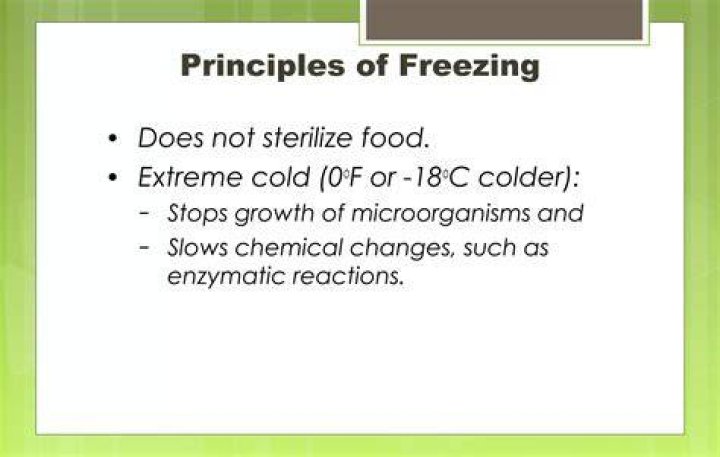
 Robert Miller