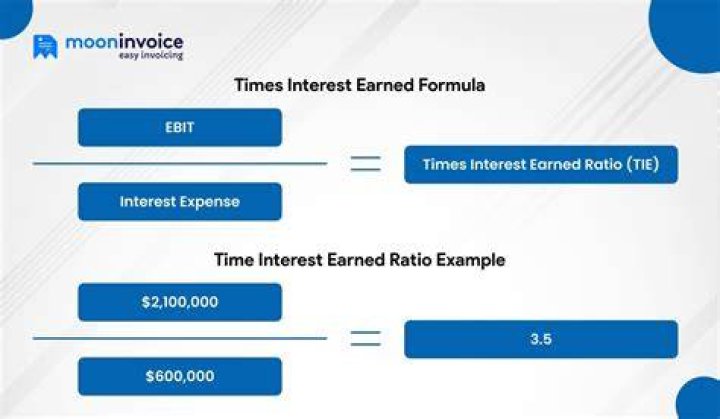
How do you calculate times interest earned?
 Nathan Sanders
 .
Just so, how do I calculate times interest earned in Excel?
Times interest earned coverage ratio is calculated by dividing the earnings before interest and taxes (operating profit) by the interest expenses. Interest expenses are the total interest payable on the total debt by the company in the balance sheet.
Also Know, what is the Sawyer's Times Interest Earned Ratio? The times interest earned (TIE) ratio is a measure of a company's ability to meet its debt obligations based on its current income. The formula for a company's TIE number is earnings before interest and taxes (EBIT) divided by the total interest payable on bonds and other debt.
Likewise, people ask, what Times Interest Earned Ratio means?
The times interest earned ratio is an indicator of a corporation's ability to meet the interest payments on its debt. The times interest earned ratio is calculated as follows: the corporation's income before interest expense and income tax expense divided by its interest expense.
Is a higher or lower Times Interest Earned Ratio Better?
A high ratio means that a company is able to meet its interest obligations because earnings are significantly greater than annual interest obligations. A lower times interest earned ratio means fewer earnings are available to meet interest payments.
Related Question Answers
What is a good debt ratio?
Generally, a ratio of 0.4 – 40 percent – or lower is considered a good debt ratio. A ratio above 0.6 is generally considered to be a poor ratio, since there's a risk that the business will not generate enough cash flow to service its debt.What is EBIT formula?
The EBIT formula is calculated by subtracting cost of goods sold and operating expenses from total revenue. This formula is considered the direct method because it adjusts total revenues for the associated expenses. You can also use the indirect method to derive the EBIT equation.Can Times Interest Earned be negative?
Also known as Times Interest Earned, this is the ratio of Operating Income for the most recent year divided by the Total Non-Operating Interest Expense, Net for the same period. If a company is loss-making, we still calculate this ratio - the figure will therefore be negative.What is a good inventory turnover ratio?
For many ecommerce businesses, the ideal inventory turnover ratio is about 4 to 6. All businesses are different, of course, but in general a ratio between 4 and 6 usually means that the rate at which you restock items is well balanced with your sales.What is a good current ratio?
Acceptable current ratios vary from industry to industry and are generally between 1.5% and 3% for healthy businesses. If a company's current ratio is in this range, then it generally indicates good short-term financial strength.How can time interest earned be improved?
Times interest earned ratio is a measure of a company's solvency, i.e. its long-term financial strength. It can be improved by a company's debt level, obtaining loans at lower interest rate, increasing sales, reducing operating expenses, etc.How is debt ratio calculated?
To calculate your debt-to-income ratio:- Add up your monthly bills which may include: Monthly rent or house payment.
- Divide the total by your gross monthly income, which is your income before taxes.
- The result is your DTI, which will be in the form of a percentage. The lower the DTI; the less risky you are to lenders.
What does debt ratio mean?
The debt ratio is a financial ratio that measures the extent of a company's leverage. The debt ratio is defined as the ratio of total debt to total assets, expressed as a decimal or percentage. It can be interpreted as the proportion of a company's assets that are financed by debt.What is a Good Times Interest Earned?
A higher times interest earned ratio is favorable because it means that the company presents less of a risk to investors and creditors in terms of solvency. From an investor or creditor's perspective, an organization that has a times interest earned ratio greater than 2.5 is considered an acceptable risk.What does interest earned mean?
Interest earned is the amount of interest earned over a specific period of time from investments that pay the holder a regular series of mandated payments. For example, interest earned can be generated from funds invested in a certificate of deposit or an interest-bearing bank account.What is leverage ratio?
The leverage ratio is the proportion of debts that a bank has compared to its equity/capital. There are different leverage ratios such as. Debt to Equity = Total debt / Shareholders Equity.What does EBIT stand for?
earnings before interest and taxes
What does a high current ratio mean?
The current ratio is an indication of a firm's liquidity. If the company's current ratio is too high it may indicate that the company is not efficiently using its current assets or its short-term financing facilities. If current liabilities exceed current assets the current ratio will be less than 1.How do you calculate profit margin ratio?
The profit margin ratio formula can be calculated by dividing net income by net sales. Net sales is calculated by subtracting any returns or refunds from gross sales. Net income equals total revenues minus total expenses and is usually the last number reported on the income statement.Is EBIT operating income?
EBIT is the net income before interest and income tax expenses are deducted. Operating incomes is a company's profit less operating expenses and other business-related expenses, such as SG&A and depreciation.How do you find interest expense?
The simplest way to calculate interest expense is to multiply a company's debt by the average interest rate on its debts. If a company has $100 million in debt at an average interest rate of 5%, its interest expense would be $100 million multiplied by 0.05, or $5 million.What does the debt to equity ratio tell us?
The debt to equity ratio is a measure of a company's financial leverage, and it represents the amount of debt and equity being used to finance a company's assets. It's calculated by dividing a firm's total liabilities by total shareholders' equity.How do you find operating income?
Formula for Operating income- Operating income = Total Revenue – Direct Costs – Indirect Costs. OR.
- Operating income = Gross Profit – Operating Expenses – Depreciation – Amortization. OR.
- Operating income = Net Earnings + Interest Expense + Taxes. Sample Calculation.