How many electrons are in a covalent bond?
 Alexander Torres
 .
Beside this, how many electrons are present in a covalent bond?
2 electrons
One may also ask, how many electrons are in a triple covalent bond? A Triple bond is when three pairs of electrons are shared between two atoms in a molecule.
In this regard, how do you calculate covalent bonds?
The number of bonds for a neutral atom is equal to the number of electrons in the full valence shell (2 or 8 electrons) minus the number of valence electrons. This method works because each covalent bond that an atom forms adds another electron to an atoms valence shell without changing its charge.
What is covalent bond with example?
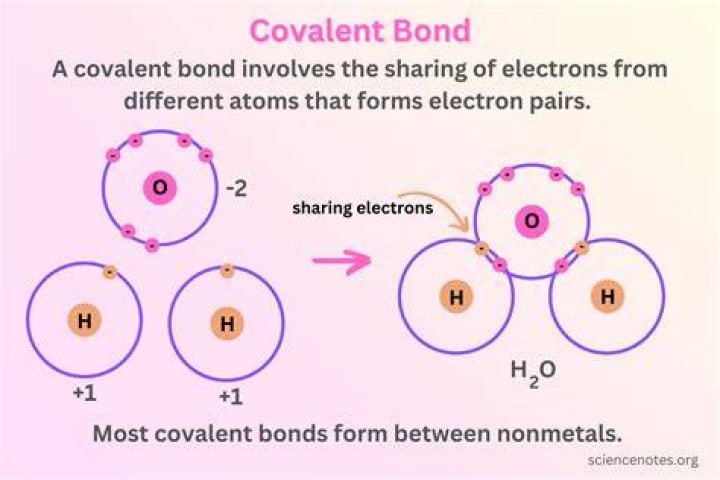
Covalent bonds are characterized by the sharing of electrons between two or more atoms. These bonds mostly occur between nonmetals or between two of the same (or similar) elements. Examples of compounds that contain only covalent bonds are methane (CH4), carbon monoxide (CO), and iodine monobromide (IBr).
Related Question Answers
Is Co a single covalent bond?
In these examples, each individual atom has just one unpaired electron to share with the other atom. When a covalent bond forms with one pair of shared electrons, we call it a single covalent bond. Methane, which is a carbon atom with single covalent bonds to four hydrogen atoms, is the simplest carbon compound.What is a polar covalent bond?
Polar covalent bonding is a type of chemical bond where a pair of electrons is unequally shared between two atoms. In a polar covalent bond, the electrons are not equally shared because one atom spends more time with the electrons than the other atom.What is meant by covalent bond?
A covalent bond, also called a molecular bond, is a chemical bond that involves the sharing of electron pairs between atoms. These electron pairs are known as shared pairs or bonding pairs, and the stable balance of attractive and repulsive forces between atoms, when they share electrons, is known as covalent bonding.Is water Polar?
A water molecule, because of its shape, is a polar molecule. That is, it has one side that is positively charged and one side that is negatively charged. The molecule is made up of two hydrogen atoms and one oxygen atom. The bonds between the atoms are called covalent bonds, because the atoms share electrons.What happens to electrons in an ionic bond?
Ionic bonding is the complete transfer of valence electron(s) between atoms. It is a type of chemical bond that generates two oppositely charged ions. In ionic bonds, the metal loses electrons to become a positively charged cation, whereas the nonmetal accepts those electrons to become a negatively charged anion.What is a polar bond?
Polar Bond DefinitionA polar bond is a covalent bond between two atoms where the electrons forming the bond are unequally distributed. This causes the molecule to have a slight electrical dipole moment where one end is slightly positive and the other is slightly negative.What are bonding electrons?
A bonding electron is an electron involved in chemical bonding. This can refer to: Covalent bond or molecular bond, a sharing of electron pairs between atoms. Bonding molecular orbital, an attraction between the atomic orbitals of atoms in a molecule.Is HBr a covalent bond?
HBr is a polar covalent bond.What type of bond is K and Cl?
Potassium atom has just one valence electron and Chlorine has 7 electrons, Cl atom needs just one more electron to complete its octet, which it receives from K atom. So an ionic bond forms between potassium and chlorine and Potassium Chloride gets formed.How many electrons are in a double covalent bond?
four electrons