Benefits of specialization include greatereconomic efficiency, consumer benefits, and opportunitiesfor growth for competitive sectors. The disadvantages ofspecialization include threats to uncompetitive sectors, therisk of over-specialization, and strategicvulnerability..
Considering this, what are the advantages of specialization?
Advantages from specialisation (division)of labour: Higher productivity and efficiency – e.g. risingoutput per person hour. Lower unit costs leading to higher profits.Encourages investment in specific capital – economies ofscale.
Furthermore, is specialization a good thing? Specialization is a good thing, but alsohas its drawbacks. Specialization is a good thing,but only if the specialization is exceptional. It is amatter of being an expert in a particular field. However, this isreasonable in a world of technology and science where you canbecome to “go-to” person.
One may also ask, what is an advantage of specialization in business?
By specializing in what they produce, workers becomemore expert at a particular part of the production process. As aresult, they become more efficient in these jobs, which lowers thecosts of production. Specialization also makes it possibleto develop tools and machines that help workers do highlyspecialized tasks.
What is an example of a specialization?
Specialization. Specialization increasesthe amount of goods and services that people produce and consume.Examples: Different community workers specialize inthe jobs they do. People also specialize when they dividethe labor on an assembly line or in an office.
Related Question Answers
What is the purpose of specialization?
Specialization is a method of production wherebyan entity focuses on the production of a limited scope of goods togain a greater degree of efficiency. Many countries, for example,specialize in producing the goods and services that arenative to their part of the world, and they trade for other goodsand services.What are the effects of specialization?
However, specialization can have both positiveand negative effects on a nation's economy. The effectsof specialization (and trade) include: Greater efficiency:Countries specialize in areas that they are naturally goodat and also benefit from increasing returns to scale for theproduction of these goods.Why work specialization is important?
One of the most important aspects of jobspecialization is its potential to increase workerproductivity and output. While productivity tends to benefit theemployer of workers, specialization can also be advantageousto workers in that it may improve employmentprospects.What is work specialization example?
It allows the manager to take complex tasks and breakthem down into smaller, more precise tasks that individual workerscan complete. An assembly line provides a good example forhow work specialization is carried out in anorganization.What is a disadvantage of specialization?
Disadvantages of Specialization. Complacency:Repetitive routine runs the risk of monotony, and boredom oftenleads to complacency, so much so that mistakes can happen. Newtasks and routines engage the brain and body, forcing aconcentrated focus. This is a huge disadvantage ofspecialization.How do we benefit from specialization and trade?
When nations specialize, this exchange creates gainsfrom trade. The benefits of specializationinclude a larger quantity of goods and services that can beproduced, improved productivity, production beyond a nation'sproduction possibility curve, and finally, resources that can beused more efficiently.What does Overspecialization mean?
Definition of overspecialize. : tospecialize to an excessive degree: such as. a intransitive : torestrict oneself to an extremely narrow field or occupationscientists who overspecialize Don'toverspecialize.What are the benefits of trade?
The advantages of tradeTrade increases competition and lowers worldprices, which provides benefits to consumers by raising thepurchasing power of their own income, and leads a rise in consumersurplus. Trade also breaks down domestic monopolies, whichface competition from more efficient foreignfirms.What is an example of a market?
A market is any place where makers, distributorsor retailers sell, and consumers buy. Examples includeshops, high streets, or websites. The term may also refer to thewhole group of buyers for a good or service. Businesses thatoperate in markets are usually in competition with othercompanies.What is the concept of comparative advantage?
Comparative advantage is an economic termthat refers to an economy's ability to produce goods and servicesat a lower opportunity cost than that of tradepartners.What are the drawbacks?
Definition of drawback. (Entry 1 of 2) 1 : arefund of duties especially on an imported product subsequentlyexported or used to produce a product for export. 2 : anobjectionable feature : disadvantage The plan's onlydrawback is its cost.Does specialization encourage employment?
Specialization can lead to economies of scalebecause it allows for increased output. This supports growth as aspecialization of labor, for example, allows workers toperfect one task rather than focus on many. As workers become moreadept at a specialized task, they become more efficient andproduction increases.What is education specialization?
From Wikipedia, the free encyclopedia. In academia,specialization (or specialisation) may be a course ofstudy or major at an academic institution or may refer to the fieldin which a specialist practices. In the case of an educator,academic specialization pertains to the subject that hespecializes in and teaches.What determines the degree of specialization within an organization?
The degree of work specialization in anorganization is determined by theorganization's structure. Work specialization is howtasks are subdivided into separate jobs within anorganization. The more a job is broken down into small tasks,the more specialization is required by each individualworker.What is a synonym for specialization?
specialization, specialisation(noun) theact of specializing; making something suitable for a specialpurpose. Synonyms: differentiation, specialism, specialty,specialisation, speciality. specialization,specialisation, specialty, speciality,specialism(noun)What are the benefits of Specialisation?
Advantages from specialisation (division)of labour:Higher productivity and efficiency – e.g. risingoutput per person hour. Lower unit costs leading to higher profits.Encourages investment in specific capital – economies ofscale.What is specialization and exchange?
Specialization - A method of production in whicheach agent (firm) concentrates on a limited number of activities.Specialization and exchange. Exchange - The act oftrading with others to obtain what we desire.What is my specialization?
specialization. If you have aspecialization, that means you focus on a specific aspect ofa larger topic. You probably notice that the word specialmakes up a big part of specialization, which can help youremember its meaning. Your specialization is yourspecial subject or skill. 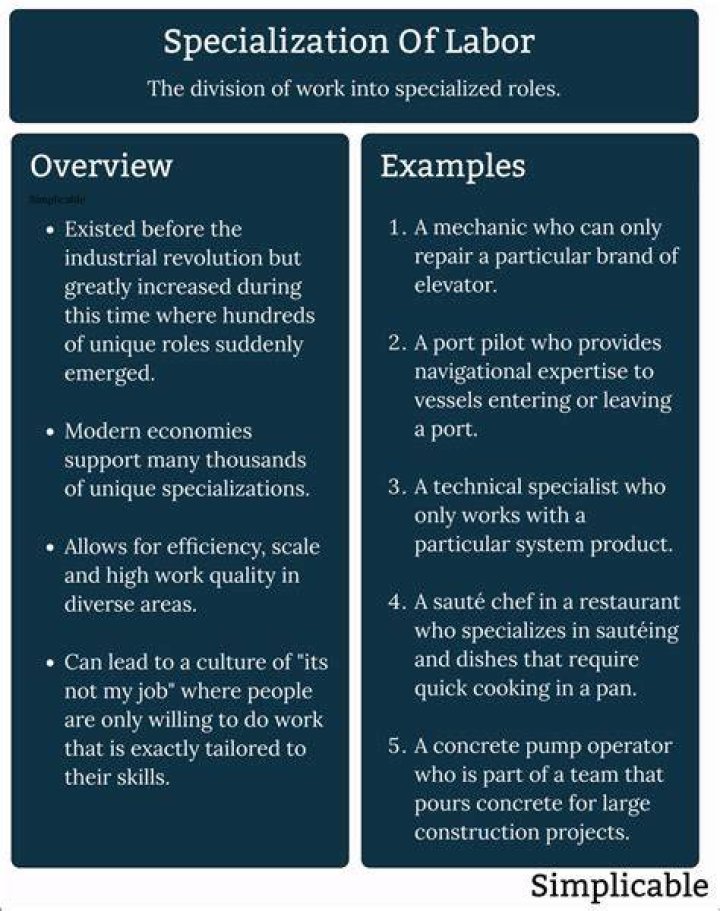
 Alexander Torres