In aqueous solution, ammonia acts as a base, acquiring hydrogen ions from H2O to yield ammonium and hydroxide ions. In contrast, the ammonium ion acts as a weak acid in aqueous solution because it dissociates to form hydrogen ion and ammonia..
Also asked, does nh3 ionize in water?
Other substances, such as ammonia (NH3), dissociate, which means they form new ions by reacting chemically. When the substance accepts protons from water, as with ammonia, it acts as a base. When it donates protons to water, it acts as an acid. Adding one to NH3 produces NH4.
Also, what does nh3 do in a reaction? Ch22: RX + NH3. Ammonia reacts as a nucleophile with alkyl halides to give primary amines in a nucleophilic substitution reaction. Yields are often poor as the product, a primary amine, RNH2, is itself a nucleophile and can react with more alkyl halide.
Then, does ammonia completely dissociate?
As you know, ammonia, NH3 , is a weak base, which means that it does not dissociate completely in aqueous solution to form ammonium ions, NH+4 , its conjugate acid, and hydroxide anions, OH− . Instead, only a fraction of the number of molecules of ammonia will actually dissociate.
Does nh3 produce H+ ions?
Nh3 is weak base so it attracts proton and h+ is proton and nh3 has one lone pair also so nh3 react with h+ and form nh4+.. it's structure will be like this.. Water is produced from the reaction of hydrogen and oxygen gas, according to the equation below.
Related Question Answers
Why is ammonia an alkali?
Ammonia is a weak base because its nitrogen atom has an electron pair that readily accepts a proton. Also, when dissolved in water, ammonia acquires hydrogen ions from water to produce hydroxide and ammonium ions. It is the production of these hydroxide ions that imparts ammonia its characteristic basicity.What happens when ammonia is mixed with water?
However, a chemical reaction also occurs when ammonia dissolves in water. In aqueous solution, ammonia acts as a base, acquiring hydrogen ions from H2O to yield ammonium and hydroxide ions. In contrast, the ammonium ion acts as a weak acid in aqueous solution because it dissociates to form hydrogen ion and ammonia.Why is ammonia a weak alkali?
The aqueous solution of ammonia is weak alkali because ammonia produces OH- ions in it's water solution. - Initially ammonia doesn't have any kind of OH- or hydroxyl ions. - But when ammonia reacts with the water ,some amount of water is dissociated and forms OH- ions with the help of the mixed ammonia.Can ammonia act as an acid?
Ammonia is normally a base, but in some reactions it can act like an acid. Ammonia acts as a base. It accepts a proton to form ammonium. Ammonia also acts as an acid.Why Ammonia is a base?
Ammonia is a weak base because its nitrogen atom has an electron pair that readily accepts a proton. Also, when dissolved in water, ammonia acquires hydrogen ions from water to produce hydroxide and ammonium ions. It is the production of these hydroxide ions that imparts ammonia its characteristic basicity.Is ammonia a base or acid?
Ammonia is normally a base, but in some reactions it can act like an acid. Ammonia acts as a base. It accepts a proton to form ammonium. Ammonia also acts as an acid.Is ammonia a base or alkali?
In all the three major theories explaining acid/base character, ammonia is a base (alkali) and the multitude of its reactions and properties converge to reinforce the classification.Why ammonia is highly soluble in water?
This is because the hydrogen atoms of ammonia are bonded with a highly electronegative Nitrogen and the hydrogen atoms of water molecules are bonded with the highly electronegative Oxygen atom. Due to these strong forces of attraction between ammonia and water molecule, ammonia is highly soluble in water.What type of reaction is ammonia?
Ammonia is industrially prepared by the Haber process, a chemical method that uses nitrogen gas and hydrogen gas to synthesize ammonia. One nitrogen gas molecule reacts with three hydrogen gas molecules over finely divided iron as a catalyst to produce two ammonia molecules.Why is ammonia added to water?
Chloramines are also used for the disinfection of drinking water and wastewater and to resist biofouling in cooling water systems. When chloramines are used as a disinfectant, ammonia is added to chlorine treated water. Chloramines can kill bacteria by penetration of the cell wall and blockage of the metabolism.How is ammonia converted to ammonium?
If the pH is low, the equilibrium shifts to the right: more ammonia molecules are converted into ammonium ions. If the pH is high (the concentration of hydrogen ions is low), the equilibrium shifts to the left: the hydroxide ion abstracts a proton from the ammonium ion, generating ammonia.How do you make a 25% ammonia solution?
From 25 to 5 % means you need to dilute 5 times. So 1/5 of 1 liter will be from the 25% solution. So take a volumetric flask of 1 liter, add 200 ml ( = 1/5th) of the 25 % solution, then add distilled water till the one liter mark, put a stopper one and shake it, done.Why acetic acid is strong acid in ammonia?
In ammonia, acetic acid acts as an acid and ammonia acts as a base. Since ammonia is a better base than water, the acid base reaction in ammonia is more "towards completion" than in water, hence improving the acidic character of acetic acid.Why is ammonia polar?
The answer is that ammonia is a polar molecule, with its polarity being influenced by its asymmetrical shape and the presence of the nitrogen and hydrogen atoms within it. The nitrogen atoms within a molecule of ammonia have more electronegativity than the hydrogen atoms, which makes it a polar molecule.Why do strong acids fully dissociate?
When HCl molecules dissolve they dissociate into H+ ions and Cl- ions. HCl is a strong acid because it dissociates almost completely. In summary: the stronger the acid the more free H+ ions are released into solution. The greater the number of free H+, the lower the pH value for that acid.How does nh4oh dissociate?
When ammonium hydroxide is dissolved in water, the ion-water attraction overcomes the attraction between ions, so it dissociates into the ammonium cation and hydroxide anion.What is the expression constant dissociation for ammonia?
Base dissociation constant (Kb) is defined as Kb = [NH4+][OH-]/[NH3]. (Brackets refer to the molar concentration of ions or molecules in the solution.) Kb is a constant at a given temperature and is usually tabulated at 25 degrees Celsius. The Kb value for ammonia is 1.8E-5 (the notation “E-5” means “ten in power -5”).What happens when nh3 reacts with water?
The NH3 molecule has a large dipole moment, and this is consistent with its geometry, a triangular pyramid. However, a chemical reaction also occurs when ammonia dissolves in water. In aqueous solution, ammonia acts as a base, acquiring hydrogen ions from H2O to yield ammonium and hydroxide ions.Is nh3 a strong base?
To illustrate this, think of ammonium, NH4+. Ammonium is a weak acid, but the conjugate base of ammonium is ammonia, NH3, which is a strong base. NH3 is a weak base. 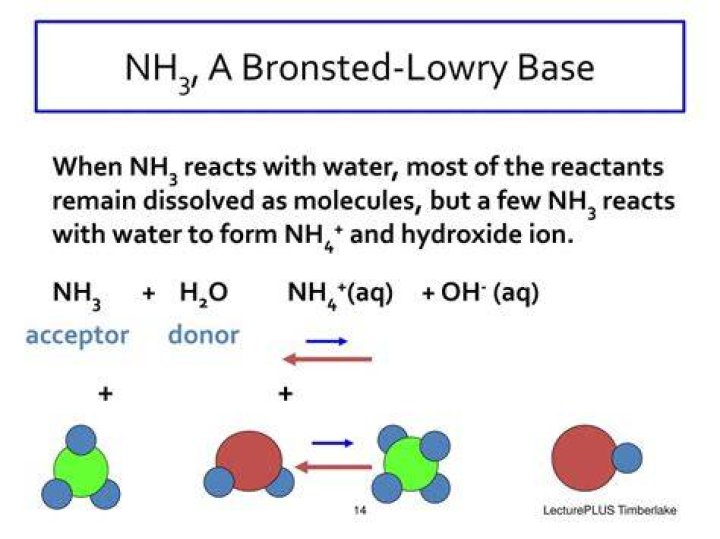
 Mia Horton