In an Isothermal process the temperature is constant. Hence, the internal energy is constant, and the net change in internal energy is ZERO. An ideal gas by definition has no interactions between particles, no intermolecular forces, so pressure change at constant temperature does not change internal energy..
Simply so, how much will be the internal energy change in isothermal process and adiabatic process?
a) Internal energy change in an isothermal process is zero. Generally, ΔU = CvΔT. For an ideal gas Cv remains constant. b) Internal energy change in an adiabatic process that changes from temperature T1 to T2 is ΔU = Cv(T2 – T1).
One may also ask, how does internal energy of a system changes during adiabatic process? An adiabatic process is one in which no heat is gained or lost by the system. The first law of thermodynamics with Q=0 shows that all the change in internal energy is in the form of work done. This puts a constraint on the heat engine process leading to the adiabatic condition shown below.
In this regard, what happens in an isothermal process?
An isothermal process is a thermodynamic process, in which the temperature of the system remains constant (T = const). The heat transfer into or out of the system typically must happen at such a slow rate in order to continually adjust to the temperature of the reservoir through heat exchange.
In which process the internal energy of a system remains constant?
The internal energy is actually determined by the motion of the molecules inside a system. In an isothermal process, temperature of the system remains constant. Thus, the internal energy of the system also remains constant. Hence the change in internal energy is 0.
Related Question Answers
Does isothermal mean no change in internal energy?
In an Isothermal process the temperature is constant. Hence, the internal energy is constant, and the net change in internal energy is ZERO. An ideal gas by definition has no interactions between particles, no intermolecular forces, so pressure change at constant temperature does not change internal energy.What is isothermal process with example?
For Example,all the reactions going on in the refrigerator are isothermal as a constant temperature is maintained in it. The melting of ice at zero degree is an example of isothermal process. The reaction in a heat pump is an example of isothermal process.On what factors internal energy depends?
Internal energy and enthalpy of ideal gases depend only on temperature. The internal energy and enthalpy of ideal gases depends only on temperature, not on volume or pressure. We can prove these property of ideal gases using property relations.What happens to internal energy during adiabatic expansion?
An adiabatic process is one in which no heat is transferred. That is, in an adiabatic expansion, the internal energy decreases - and hence the temperature drops.What does isothermal process mean?
An isothermal process is a change of a system, in which the temperature remains constant: ΔT =0. In contrast, an adiabatic process is where a system exchanges no heat with its surroundings (Q = 0).What is adiabatic process example?
An example of an adiabatic process is the vertical flow of air in the atmosphere; air expands and cools as it rises, and contracts and grows warmer as it descends. Another example is when an interstellar gas cloud expands or contracts. Adiabatic changes are usually accompanied by changes in temperature.Can a process be isothermal and adiabatic?
1 Answer. If a process is both isothermal and adiabatic, it is implied that the work done on the system is being stored somewhere other than the internal energy of the working fluid. Thus, the whole process would be both adiabatic and isothermal. I don't know of such a reaction, but it is certainly possible.Is boiling an isothermal process?
Boiling water is an isothermal process as the temperature of the water stays at 1000C even though you add heat to the system. The equation changes in an adiabatic system to dE = -W since the change in q = 0. The simplest system to use to understand these process is the expansion of a gas.What are the conditions for isothermal process?
Essential conditions for isothermal process are: i) The container should be perfectly conducting to the surroundings. ii) The process must be carried out very slowly so that there is sufficient time for exchange of heat with the surroundings so that temperature remains constant.Is isothermal process reversible?
Just being isothermal does not necessarily make a process reversible. There are plenty of isothermal processes that are not reversible. The other two legs (4 to 1 and 2 to 3) are adiabatic compression or expansion and the temperature changes but they are reversible processes.How do you know if work is done on or by the system?
If energy enters the system, its sign is positive. If energy leaves the system, its sign is negative. If work is done on the system, its sign is positive. If work is done by the system, its sign is negative.Is isobaric process reversible?
There is no connection of a process being isobaric and being reversible. There is no connection of a process being isobaric and being reversible. Both are two different concepts but usually people gets confused in this just because the formula of work done is same for both cases.What is the equation for isothermal process?
For an isothermal, reversible process, the work done by the gas is equal to the area under the relevant pressure -volume isotherm. It is given as WA→B=NkTlnVBVA W A → B = NkT ln ? V B V A .What is difference between adiabatic and isothermal?
In very laymen terms it can be told that isothermal is the process where WORK is done between the same temperature difference,whereas in adiabatic the work is done where there is NO heat or temperature difference is there . As according to first law (conservation of energy) where Heat is converted to work .What does Polytropic mean?
The term "polytropic" was originally coined to describe any reversible process on any open or closed system of gas or vapor which involves both heat and work transfer, such that a specified combination of properties were maintained constant throughout the process.Does adiabatic mean no temperature change?
An adiabatic process has a change in temperature but no heat flow. The isothermal process has no change in temperature but has heat flow.Why is adiabatic process important?
The adiabatic process has been important for thermodynamics since its early days. It was important in the work of Joule, because it provided a way of nearly directly relating quantities of heat and work. The first is an isochoric adiabatic work process that adds to the system's internal energy.What is the equation for adiabatic process?
For an adiabatic process, Q = 0 , so dU = -W = -p dV = Cv dT . From the ideal gas law, pV = RT (n= 1), p dV + V dp = R dT and we have that R = Cp - Cp .What is CP and CV?
Cp is an amount of heat required to raise temperatire of an unit mass (1kg) by 1 degree Celsius when the system is at constant pressure. And Cv is an amount of heat required to raise the temperature of a unit mass by 1 degree Celsius when the volume of the system is constant. 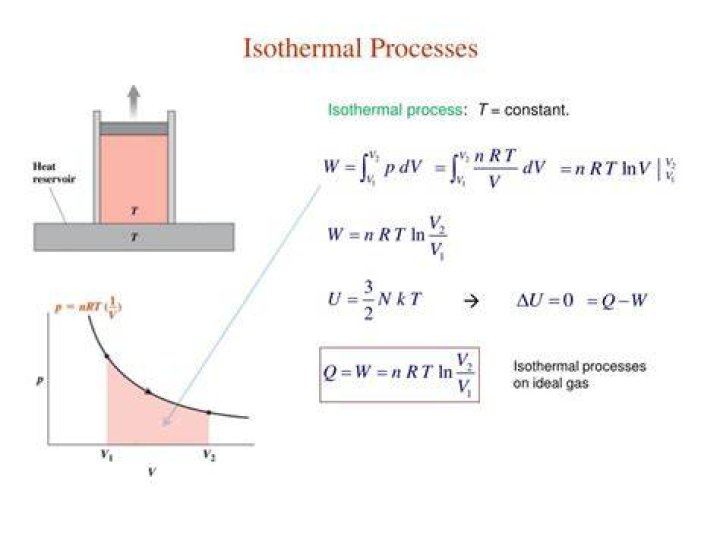
 David Jones