What is an example of a plural verb?
 David Jones
 .
Simply so, what are plural verbs?
Plural Verbs. The most important thing to remember about plural verbs is that they don't end in an "s." The plural verb matches the plural subject, which is a noun, but don't add an "s" to the verb.
what are the examples of subject verb agreement? Here are some examples of subject verb agreement with singular indefinite pronouns:
- Each gets a trophy for playing.
- Somebody will pay for this.
- Anybody is more fun than you.
- Something is very wrong here.
- Everybody enjoys a good book.
- Nothing has been determined as of yet.
Hereof, what is a singular verb examples?
Singular Verbs: is, was, has, does, ( all s/es verbs ). Eg. loves, comes, goes, sits,etc. These are used with the third person singular subjects. Plural Verbs : are, were, have, do, ( all vi) eg.
How do you identify a plural verb?
Check the end of the verb. As a rule, if the last letter of the verb is s, it is singular, while if it is not, the verb is plural. Remember that this only applies to the third person. First or second person plural verbs do not have an s; they are identical to the singular verb.
Related Question Answers
Is the word is a verb?
Is is a verb? Is is what is known as a state of being verb. State of being verbs do not express any specific activity or action but instead describe existence. The most common state of being verb is to be, along with its conjugations (is, am, are, was, were, being, been).Is ARE AN sentence?
If the noun is singular, use is. If it is plural or there is more than one noun, use are. The cat is eating all of his food. The cats are eating all of their food.What is the plural of need?
needs
What is the plural of go?
Both 'go' and 'goes' are in simple present tense. 'Go' is used in plural number and 'Goes' is used in Singular number.What is a subject and a verb?
The subject in a sentence, phrase, or clause is the person, place, or thing doing the action. The subject can be a noun or pronoun. The verb is the action word or the state-of-being (stative) word. Below are some examples showing the subject of the verb. The subject is bold, and the verb is italicized.Where do you put S in a verb?
In English, the -s is only added to regular verbs in the present tense when the subject of the verb is a third person singular subject. This -s is different from the plural -s. Do not confuse the two. The subject "Lisa and Ronald" is a third person plural subject, so the verb does not get an -s.What are plurals examples?
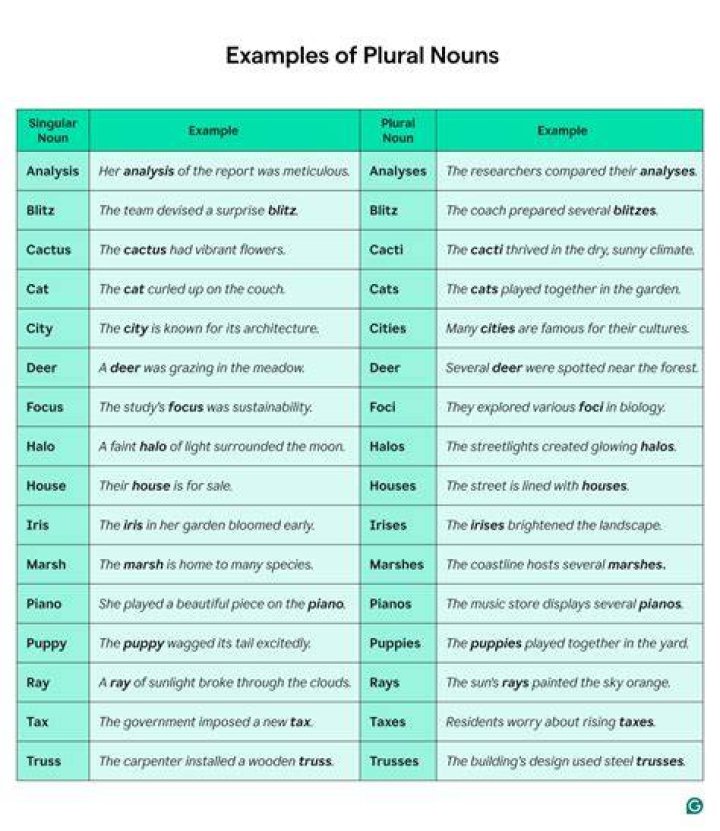
Nouns that end in -ch, x, s, z or s-like sounds, however, will require an es for the plural:- more than one witch = witches.
- more than one box = boxes.
- more than one gas = gases.
- more than one bus = buses.
- more than one kiss = kisses.
Who is plural or singular?
'Who' is a pronoun used both for singular and plural nouns. It takes a singular or plural verb in accordance to the noun it refers to.How do you use plural in a sentence?
Plural in a Sentence ??- According to the grammar book, the plural of the word mouse is mice.
- Women is the plural form of woman but womans is not.
- A plural form of the word child should be used when there is more than one present.
- The student was marked off for writing the plural form of the word goose as gooses.
How do you singular and plural in a sentence?
Basic Rule.A singular subject (she, Bill, car) takes a singular verb (is, goes, shines), whereas a plural subject takes a plural verb. Example: The list of items is/are on the desk. If you know that list is the subject, then you will choose is for the verb.What is the 10 rules on subject verb agreement?
So the correct sentence is: The quality of the apples was not good. RULE1: The subject and verb must agree in number: both must be singular, or both must be plural. RULE2: The number of the subject (singular or plural) is not changed by words(or a phrase) that come in between the subject and the verb.What is a subject in a sentence?
The subject of a sentence is the person, place, thing, or idea that is doing or being something. You can find the subject of a sentence if you can find the verb. Ask the question, "Who or what 'verbs' or 'verbed'?" and the answer to that question is the subject.Which tense is always helping verb?
PERFECT tense