What is the meaning of call and response?
 Andrew Vasquez
 .
Simply so, what is the purpose of call and response?
In music, call and response is a technique where one musician offers a phrase and a second player answers with a direct commentary or response to the offered phrase. The musicians build on each other's offering and work together to move the song along and create a sound that's inventive and collective.
Also, what is the structure of a call and response song? This well-known cheer is a form of call and response. Call and response is a musical form in which a melody is stated in a phrase that is then followed by a second phrase that completes the idea. The first phrase is presented like a question, prompting the second phrase - the reply.
Then, where does call and response come from?
Call-and-response originated in Sub-Saharan African cultures, which used the musical form to denote democratic participation in public gatherings like religious rituals, civic gatherings, funerals, and weddings.
What are some examples of call and response singing?
Call-and-response songs
- A Girl Like You - Edwyn Collins.
- Boys Keep Swinging - David Bowie.
- Bring It On Home To Me - Sam Cooke.
- Come And Get Your Love - Redbone.
- Déjà Vu - Post Malone.
- Despair And Traffic - Slaves.
- Hello, You Beautiful Thing - Jason Mraz.
- I'll Take You There - The Staple Singers.
Related Question Answers
What does it mean to respond to music?
In music, a call and response is a succession of two distinct phrases usually written in different parts of the music, where the second phrase is heard as a direct commentary on or in response to the first.What is call and response in education?
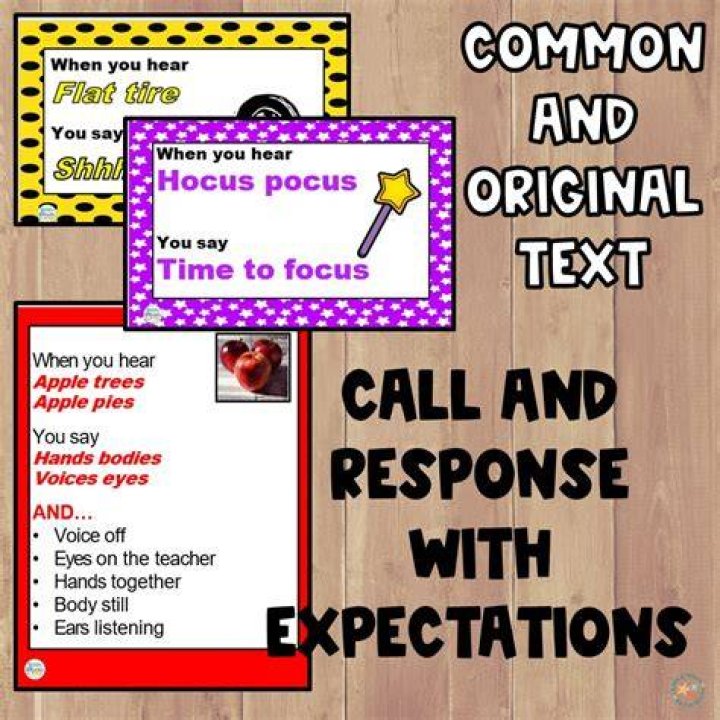
Call and Response is when students verbally respond in unison with an identical statement to a "call" (e.g., a statement or question). "Call" elicits a specific, explicitly taught response from the students. Phrases are age-appropriate and easy to remember.What is call and response in literature?
Call and response is a form of interaction between a speaker and an audience in which the speaker's statements ("calls") are punctuated by responses from the listeners.What is black music called?
Rhythm and blues (R&B) is a term that has been used to describe many African American music genres, including electronic blues, soul, funk, disco, and contemporary pop.What is call and response in dance?
call and response: a structure often associated with African music and dance forms, although it is also used elsewhere, including in classical, folk, traditional, and other primal forms. One soloist/group performs, with the second soloist answering or entering in “response.”Is call and response polyphonic?
Polyphonic means 'many sounds'. The instruments playing may all have different melodies that overlap and weave together to create the music. Call and Response music is exactly that, a 'call' tune (often a solo) is followed by a 'response' tune (often a group of instruments).Did music come from Africa?
African music is a tradition mainly played at gatherings at special occasions the traditional music of Africa, given the vastness of the continent, is historically ancient, rich and diverse, with different regions and nations of Africa having many distinct musical traditions.How do blues musicians use call and response?
The idea is simple: a statement is made or a question asked, and the response or answer follows. Sometimes the response is simply a repetition of the leader's call, and sometimes it's a traditional statement of affirmation. You hear this in music of all kinds, but most notably in the blues.Who invented the blues?
The blues originated on Southern plantations in the 19th Century. Its inventors were slaves, ex-slaves and the descendants of slaves—African-American sharecroppers who sang as they toiled in the cotton and vegetable fields.What does round mean in music?
A round (also called a perpetual canon [canon perpetuus] or infinite canon) is a musical composition, a limited type of canon, in which a minimum of three voices sing exactly the same melody at the unison (and may continue repeating it indefinitely), but with each voice beginning at different times so that differentWhat is the name of the person who sings or chants a solo line in the style of call and response?
Responsorial singing, also known as call-and-response, is found in the folk music of many cultures—e.g., Native American, African, and African American. One example from the rural United States is the lining out of hymns in churches: a leader sings a hymn line, which is then repeated by the congregation.What are work songs and field hollers?
Field Hollers & Work Songs. Field hollers and work songs stem from the oral tradition of African music. These songs were performed by slaves as they worked on plantations, hollering to each other across the fields, worshipped together or at other gatherings for entertainment.What does antiphonal mean in music?
Antiphonal music is that performed by two choirs in interaction, often singing alternate musical phrases. Antiphonal psalmody is the singing or musical playing of psalms by alternating groups of performers. The term “antiphony” can also refer to a choir-book containing antiphons.What are African instruments often made of?
Materials for the instruments are usually from nature, like wood, gourds, turtle shells, animal horns or skin. Other materials might be recycled from man-made objects, like scrap metal from old cars or oil drums.What does ostinato mean in music?
Ostinato, (Italian: “obstinate”, )plural Ostinatos, or Ostinati, in music, short melodic phrase repeated throughout a composition, sometimes slightly varied or transposed to a different pitch. A rhythmic ostinato is a short, constantly repeated rhythmic pattern.How are blues songs structured?
The twelve-bar blues (or blues changes) is one of the most prominent chord progressions in popular music. The blues progression has a distinctive form in lyrics, phrase, chord structure, and duration. In its basic form, it is predominantly based on the I, IV, and V chords of a key. The blues can be played in any key.What does improvisation mean in music?
Musical improvisation (also known as musical extemporization) is the creative activity of immediate ("in the moment") musical composition, which combines performance with communication of emotions and instrumental technique as well as spontaneous response to other musicians.What is the function and musical style of the African American work song?
Work songs helped to pass down information about the lived experience of enslaved people to their communities and families. A common feature of African American songs was the call-and-response format, where a leader would sing a verse or verses and the others would respond with a chorus.What is a question and answer pattern in which a group responds to a leader?
Chapter 3 Review
| A | B |
|---|---|
| A question-and-answer pattern in which a group responds to a leader is called ___________. | call and response |
| T or F A listener can decide how much attention to give to the music. | true |
| T or F Music critics do not have much influence on public opinion | false |