Who gave diamond paradox?
 Alexander Torres
 economist Adam Smith
.
Herein, who Solved the diamond water paradox?
answer to the so-called “diamond-water paradox,” which economist Adam Smith pondered but was unable to solve. Smith noted that, even though life cannot exist without water and can easily exist without diamonds, diamonds are, pound for pound, vastly more valuable than water.
Similarly, why is the price of water so low relative to the price of diamonds? Enter Demand Price The price of water is relatively low because the marginal utility is relatively low. The price of diamonds is relatively high because the marginal utility is relatively high. In general, people are willing to pay a relatively higher demand price for a good that generates relatively more satisfaction.
In respect to this, what is diamond water paradox in economics?
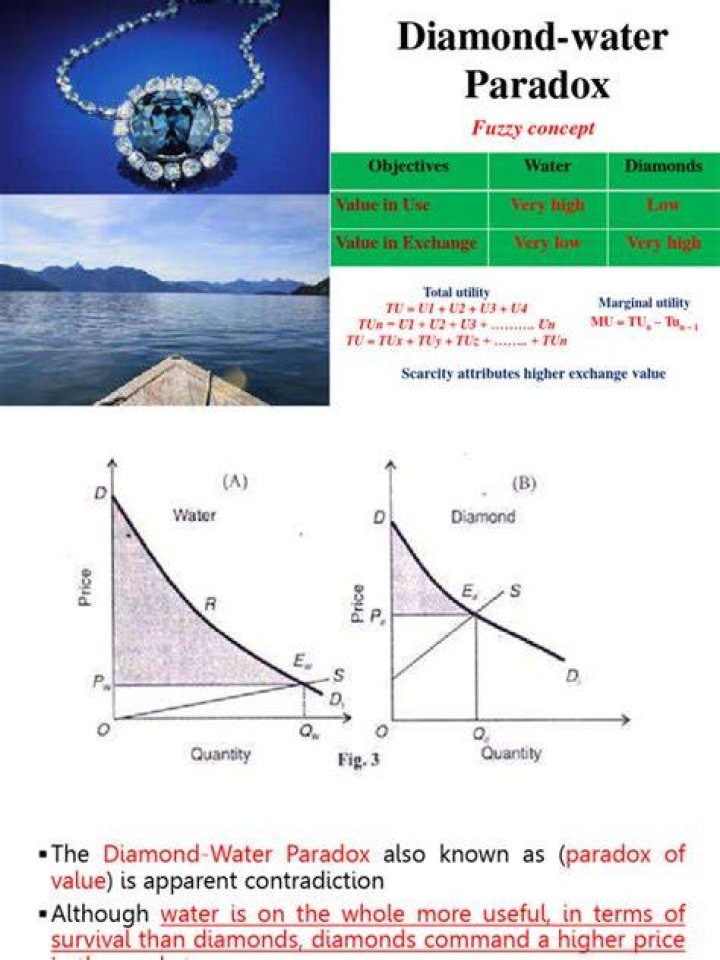
The paradox of value (also known as the diamond–water paradox) is the contradiction that, although water is on the whole more useful, in terms of survival, than diamonds, diamonds command a higher price in the market.
Why does the paradox of value exist?
paradox of value. Observation that articles or goods critical to life (such as water) are very cheap, whereas others which have no bearing on human existence (such as diamonds) are very expensive. This paradox is explained by the law of supply and demand.
Related Question Answers
Could a water bottle be more valuable than a diamond?
The first bottle of water is worth more to you than any amount of diamonds, but eventually, you have all the water you need. After a while, every additional bottle becomes a burden. That's when you begin to choose diamonds over water.What is the key to resolving the diamond water paradox?
State and solve the diamond-water paradox. The paradox is that water, which is essential to life, is cheap, and diamonds, which are not essential to life, are expensive. The solution to the paradox depends on knowing the difference between total and marginal utility and the law of diminishing marginal utility.Does diamond water still exist?
During the first few episodes of the first season of Shahs of Sunset, Asa talks about the Diamond water that she makes at home. Diamond water is pretty much diamonds soaked in water that she swears by. Years later you can still spot Diamond water being sold at your local Ross store.Why is water so cheap?
It is cheap in many areas because of the abundance of natural rainwater and high water tables. There are certain areas that get more expensive because of natural events and government intrusion. California makes illogical laws directing fresh water into the ocean instead of man's use increasing dependency on aquifers.Is water worth more than gold?
In fact, water has become more precious than gold. In fact, water outperformed the stock market in the same period. While the planet Earth is primarily covered in water, only 2.5% of it is fresh, and only a portion of that is drinkable. In fact, many global agencies now say human kind is in a water crisis.What is the paradox of value and how is the paradox resolved?
The paradox of value (also known as the diamond–water paradox) is the apparent contradiction that, although water is on the whole more useful, in terms of survival, than diamonds, diamonds command a higher price in the market. How is it solved? By the concept of marginal utility.Why does the paradox of value between diamonds and water arise?
marginal benefit. The marginal utility of water is small but the total utility is enormous. The paradox of value with respect to water and diamonds can be explained using consumer surplus because. water is cheap but provides a large consumer surplus, while diamonds are expensive with a small consumer surplus.What is total utility and marginal utility?
Total utility is the total satisfaction received from consuming a given total quantity of a good or service, while marginal utility is the satisfaction gained from consuming an additional quantity of a particular good or service.What is economic paradox?
Definition: Paradox in economics is the situation where the variables fail to follow the generally laid principles and assumptions of the theory and behave in an opposite fashion. Description: Paradoxes are very common in economics.What causes diminishing marginal utility?
Less Important Uses of Additional Quantities:Furthermore, marginal utility diminishes because a person, having several units of a commodity capable of alternative uses, puts one unit to its most important use and the additional units to the successively less important uses.How is a nation's wealth determined?
Wealth measures the value of all the assets of worth owned by a person, community, company, or country. Wealth is determined by taking the total market value of all physical and intangible assets owned, then subtracting all debts.What do you need for value?
For something to have value, it must have utility, or the capacity to be useful and provide satisfaction.Is Diamond a scarce resource?
You are probably used to thinking of natural resources such as titanium, oil, coal, gold, and diamonds as scarce. In fact, they are sometimes called “scarce resources” just to re-emphasize their limited availability. Most people don't think of water as scarce, but if you live in a desert, water is scarce.What are the different types of goods?
There are four different types of goods in economics which can be classified based on excludability and rivalrousness: private goods, public goods, common resources, and club goods. Private Goods are products that are excludable and rival. Public goods describe products that are non-excludable and non-rival.Why are diamonds so expensive?
MYTH #1: Diamonds are expensive because they're so rare.In fact, compared to other gemstones, they're the most common precious stone found. Generally, the cost per carat (or weight of a gemstone) is based upon a stone's rarity; the rarer the stone, the more expensive.Who made diamond water?
Asa Soltan Rahmati