The pulse is checked at the wrist, where the radial artery is closest to the surface. The radial artery is also commonly used when drawing arterial blood for 'Arterial Blood Gas' (ABG) measurement. This is done for three reasons: firstly, it is not the only supplier of blood to the arm..
Hereof, what is the radial pulse?
n pulse of the radial artery (felt in the wrist) Type of: heart rate, pulse, pulse rate. the rate at which the heart beats; usually measured to obtain a quick evaluation of a person's health.
Secondly, why is the carotid pulse stronger than the radial pulse? Answer and Explanation: The carotid artery is the strongest pulse because it is in an artery that is relatively large, close to the skin's surface and relatively close to the
Furthermore, why is radial artery always chosen?
An indwelling arterial catheter allows for continuous blood pressure monitoring, frequent blood sampling, and arterial blood gas measurement. The radial artery is chosen for cannulation primarily because of the superficial nature of the vessel and ease of maintenance of the site.
What causes the pulse to occur?
Pulse, rhythmic dilation of an artery generated by the opening and closing of the aortic valve in the heart. A pulse can be felt by applying firm fingertip pressure to the skin at sites where the arteries travel near the skin's surface; it is more evident when surrounding muscles are relaxed.
Related Question Answers
What should I do if my radial pulse is irregular?
If the pulse is regular, count the rate for 30 seconds and multiply the total by 2. 15. If the pulse is irregular, count the rate for a full 60 seconds.How do you take a radial pulse?
This is known as the radial pulse: - Turn one hand over, so it is palm-side up.
- Use the other hand to place two fingertips gently in the groove on the forearm, down from the fold of the wrist and about an inch along from the base of the thumb.
- When the position is right, you should feel the pulsation of your heart beat.
What is a normal radial pulse?
Pulse is symmetrical, regular and between 60-90 per minute. You have to learn to appreciate the character and amplitude of the normal pulse.What does a weak radial pulse mean?
Your pulse is the rate at which your heart beats. A weak or absent pulse is considered a medical emergency. Usually, this symptom indicates a serious problem in the body. A person with a weak or absent pulse will often have difficulty moving or speaking. If someone has this condition, call 911 immediately.What does a 2+ radial pulse mean?
Pulses. Palpation should be done using the fingertips and intensity of the pulse graded on a scale of 0 to 4 +:0 indicating no palpable pulse; 1 + indicating a faint, but detectable pulse; 2 + suggesting a slightly more diminished pulse than normal; 3 + is a normal pulse; and 4 + indicating a bounding pulse.What is normal pulse by age?
The normal resting heart rate for adults over the age of 10 years, including older adults, is between 60 and 100 beats per minute (bpm). Highly trained athletes may have a resting heart rate below 60 bpm, sometimes reaching 40 bpm.Where is the radial pulse located?
Radial pulse: located on the lateral of the wrist (radial artery). It can also be found in the anatomical snuff box. Ulnar pulse: located on the medial of the wrist (ulnar artery).At what blood pressure do you lose radial pulse?
The advanced trauma life support course teaches that if only the patient's carotid pulse is palpable, the systolic blood pressure is 60-70 mm Hg; if carotid and femoral pulses are palpable, the systolic blood pressure is 70-80 mm Hg; and if the radial pulse is also palpable, the systolic blood pressure is more than 80Why is the radial artery used for ABG?
The radial artery is also commonly used when drawing arterial blood for 'Arterial Blood Gas' (ABG) measurement. This is done for three reasons: firstly, it is not the only supplier of blood to the arm. If the radial artery is damaged, the ulnar artery will take over. Secondly, it is easy to access.Why does my radial artery hurt?
Radial nerve injury may be due to physical trauma, infection, or even exposure to toxins. It often causes numbness and tingling or burning pain. It can also be painless. The condition may cause weakness or difficulty moving your wrist, hand, or fingers.How do you find the radial artery?
Palpate the distal end of the radius; then draw two or three fingers towards the radial artery. Move a few fingers proximally as you lightly scan to locate the radial artery. Palpate the base of the patient's thumb; then draw two or three fingers proximally towards the radial artery.How do you stop a radial artery from bleeding?
When you apply pressure to an artery, you stop bleeding by pushing the artery against bone. Press down firmly on the artery between the bleeding site and the heart. If there is severe bleeding, also apply firm pressure directly to the bleeding site. to an artery for longer than 5 minutes.How big is the radial artery?
The mean diameter of all the radial arteries was 2.325 ± 0.4 mm.What artery is in your wrist?
The ulnar artery is the main blood vessel, with oxygenated blood, of the medial aspect of the forearm. It arises from the brachial artery and terminates in the superficial palmar arch, which joins with the superficial branch of the radial artery. It is palpable on the anterior and medial aspect of the wrist.How deep is your radial artery?
Set the depth of field to provide the maximum magnification. The anterior wall of the typical radial artery is 3 mm under the skin, so a lot of depth is not necessary.What does it mean to Cannulate an artery?
Arterial cannulation is a procedure frequently performed in acute and critical care settings. It serves as an invasive means to more accurately measure blood pressure and mean arterial pressure than non-invasive means.What is the strongest pulse point?
Carotid pulse: the common or external carotid artery can be palpated in the anterior triangle of the neck. This is one of the strongest pulses in the body.Which arterial pulse is the easiest to feel?
As the heart pumps, the arteries expand and contract. This is the pulse. The pulse is easiest to find on the wrist or neck. A healthy pulse is between 60 and 100 beats per minute (bpm).Which pulse is used when taking the blood pressure?
The pulse can be felt with the fingers at different pulse pressure points throughout the body and heard through a listening device called a stethoscope. In this survey you will use the radial pulse (at the wrist) and the brachial pulse (inside of arm at the elbow), to obtain the pulse and blood pressure measurements. 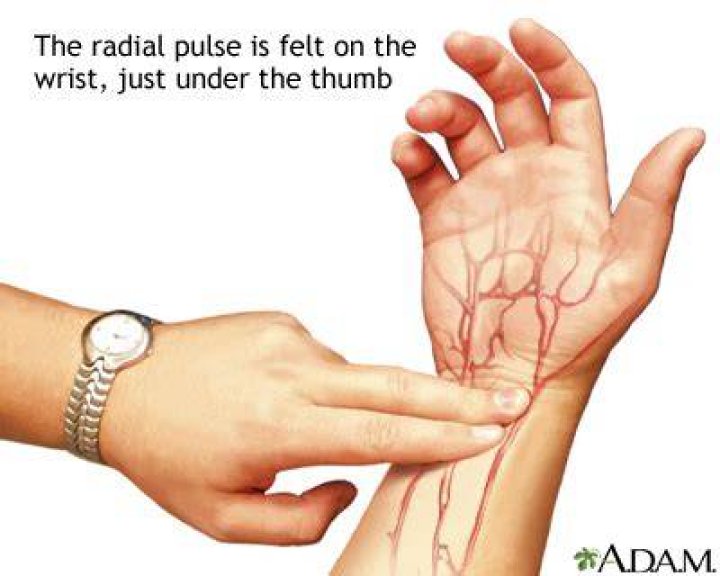
 Robert Miller